TL;DR - If your priority is scaling multi-channel outreach with a single, centralized workflow, deliverability-first infrastructure, and a tool that supports unlimited sending accounts and reply management out of the box, Salesforge is the platform I’d pick. Outreach is preferable if your organization needs complex enterprise analytics, long-running account plans, and strong conversation intelligence. Yesware could be the right fit if you want a lightweight, email-only outreach tool with simple capabilities, and an affordable per-seat model catered towards smaller teams.
Introduction
I set out to evaluate three prominent tools in the cold outreach space: Outreach, Yesware and Salesforge. I pit them head-to-head across a set of practical and relevant criteria I use when picking a cold outreach tool, such as pricing, multi-channel outreach capabilities, deliverability and sender reputation, personalization, customer support and resources, scalability, campaign management, and more, to help you pick the right option for your business.
Comparison Table
Criteria
Salesforge
Outreach
Yesware
Pricing
Starts from $48/mo/company
Contact for pricing
Starts from $19/mo/user
Free Version / Trial
14-day free trial
❌
Free plan with very limited features
Team Usage
Unlimited LinkedIn senders, mailboxes, shared workspaces and seats with Growth plan ($96/mo)
Scales with pricing
Scales with pricing
Multichannel Outreach
✅
✅
❌
Outreach Channels
LinkedIn + email (phone planned in the future)
LinkedIn + email + phone
Email (with some LinkedIn touches, Sales Navigator subscription is required)
Major CRMs, API, Zapier, webhooks, Make, Clay, Sendspark, telephony
Salesforce, Zoom, Clari, DocSend, Teams
Outreach, Yesware and Salesforge: Sales Engagement Platform Key Features
From my experience:
Outreach is an AI Revenue Workflow Platform that spans prospect engagement, conversation intelligence, and deal management. The company piques my interest when it comes to surfacing revenue intelligence to help reps and managers prioritize deals and forecast more accurately, but it's similarly focused towards teams running larger-scale operations and wouldn't be as approachable for smaller teams.
Yesware is a lightweight, Gmail/Outlook-centric tool for fast but basic email automation and email tracking. It’s a simple and cheap (though priced per-seat) option that focuses on email campaigns, quick scheduling features, email templates, and basic reporting features.
Salesforge is the perfect central outreach stack for teams of all sizes. It combines multi-channel sequences, unlimited mailboxes and LinkedIn senders, state-of-the-art deliverability capabilities, several proprietary infrastructure options, and even an optional AI SDR (Agent Frank) for finding, qualifying and reaching out to leads - all in my sleep. Hands-on customer support are available 24/5 and the unified inbox (Primebox) helped me treat replies consistently across channels, which reduced manual triage as well.
Transparent Pricing Structure & Free Trials - Which Tool Provides The Highest & Quickest ROI?
Salesforge provides 2 plans oriented around outreach scale and a 14-day free trial (with 2 free months granted when billed annually):
$48/mo for Pro plan (you get: 1000 active contacts in sequence, 5000 messages/mo, 100 email validation credits/mo, 100 personalization credits/mo, unlimited mailboxes, unlimited contact storage, free premium warm up via Warmforge, unlimited workspaces, connect unlimited mailboxes, a unified inbox (Primebox), mailbox rotation, dynamic IPs, live chat support and more)
$96/mo for Growth plan (you get: 10x the credits from the Pro plan, unlimited seats, A/B testing, personal onboarding, API access, 100 social action credits/month, multi-language sequences, Primebox AI reply crafting, ESP matching, access to a massive knowledge base and more)
Outreach's pricing is quote-based, so it's dependent on the business, and starting pricing likely doesn't go below triple digits.
Yesware provides 3 tiered plans oriented around outreach scale + a very limited free tier (annual billing saves up to ~23%):
$19/seat/month for Pro plan (You get: unlimited email open/link/attachment tracking, 20 campaign recipients/month, personal activity & recipient engagement reports, email & phone support, templates & meeting scheduler, campaign building from Gmail/Outlook)
$45/seat/month for Premium plan (You get: everything in Pro + removes Yesware branding, unlimited campaigns, unlimited teams, shared templates & campaigns, team reporting, centralized team billing, customer success)
$85/seat/month for Enterprise plan (You get: everything in Premium + Salesforce Inbox sidebar, email & reply sync, calendar sync, background & bi-directional activity sync, import Salesforce list views to campaigns, SSO, trusted IP ranges, some more enterprise controls.
Multichannel Campaign Management
Modern sales outreach is rarely email-only. From my experience, prospects experiencing coordinated touches across channels (combining email automation with LinkedIn outreach) always results in more wins.
Salesforge emphasizes this multi-channel approach heavily with conditional multi-channel sequences and built-in deliverability tools so scaled sending does not degrade inbox placement.
For teams that run outreach at scale, Salesforge's combination of unlimited LinkedIn senders, unlimited mailboxes, unlimited shared workspaces, and even unlimited seats reduces the need to cobble together separate tools for LinkedIn connections and proves that scale won't provide any ceiling.
Outreach is strong at orchestrating multi-touch, enterprise-level sequences and excels when organizations need robust native integrations and deep CRM syncing. Outreach helps large sales organizations by offering advanced sequence branching, rule-based task assignments, and analytics that tie outreach to pipeline outcomes.
Its enterprise focus means it’s engineered for companies that run complex outbound programs across many departments and can afford it.
Yesware’s value is its lightweight handling of email campaigns, but nothing noteworthy in the realm of multi-channel outreach. It’s great for sellers who want fast email automation, scheduling tools (meeting scheduler), email templates, and straightforward email tracking.
Ultimately, since Yesware is primarily email-centric, its multichannel depth - especially around LinkedIn outreach - is much more limited compared to Salesforge or Outreach.
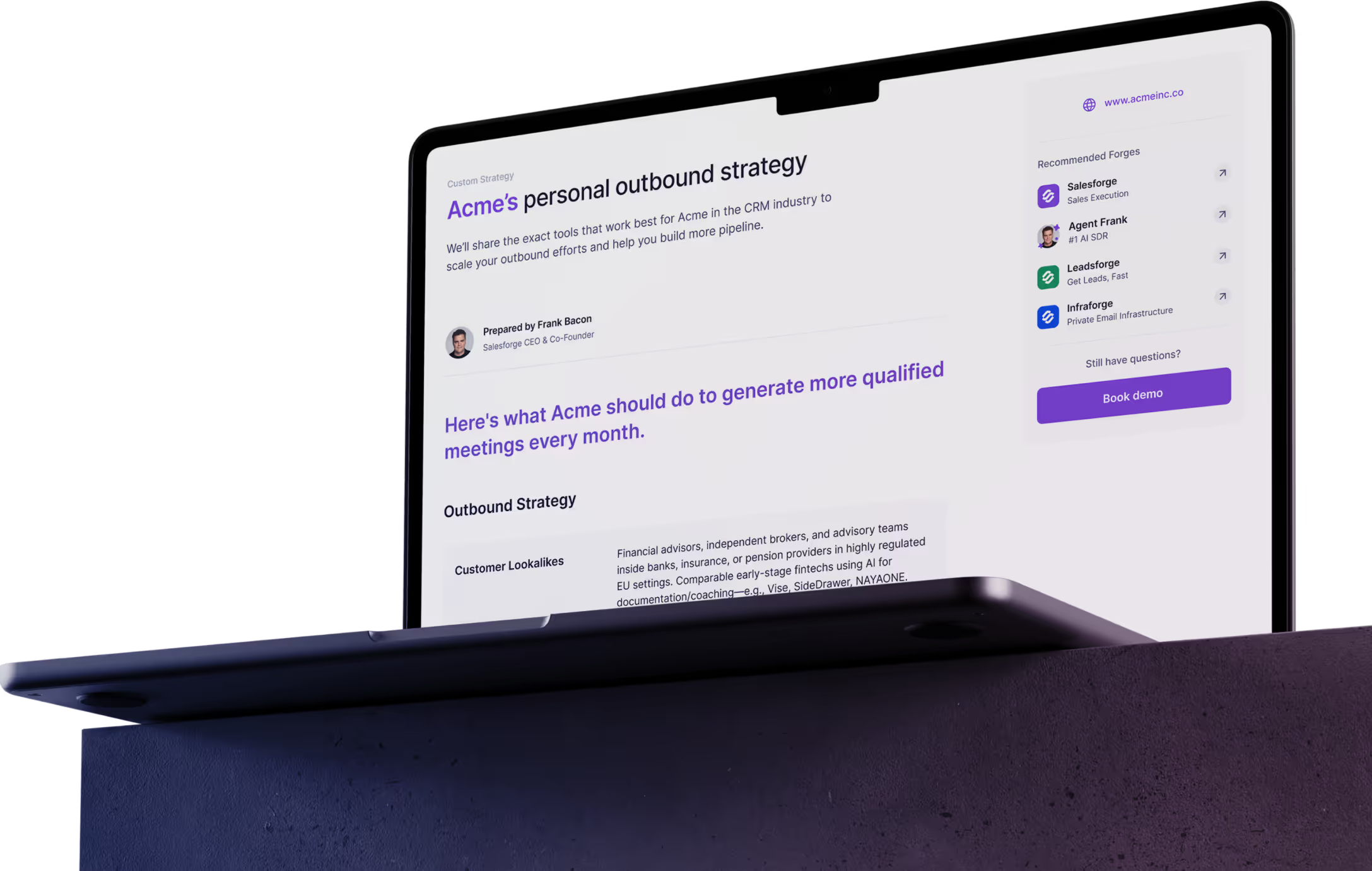
Personalized Outbound Strategy
Get The Right Outbound Strategy In Minutes
Enter your email to get a custom plan & stack recommendation for your
business
It's being carefully crafted by AI
Please check your mailbox in 5 minutes
Deliverability & Proprietary Infrastructure
Deliverability is the single biggest hidden cost of cold email marketing. If your emails land in spam, nothing else matters. This is one area where Salesforge differentiates itself:
And more. Building sender reputation gradually while spreading volume across addresses and IPs to avoid single-mailbox throttles or sudden reputation hits is crucial for a scaling business. And that's paired with proprietary infrastructure options:
Or your team can connect custom infrastructure if they so choose
Those infrastructure features reduce the risk of landing in spam and make multi-channel outreach more reliable, especially when you have a leads database and want to integrate email at scale.
Outreach's focus is catered more towards workflow automation and deep CRM syncs for enterprise-level clients. It provides basic necessities, such as best-practice guidance and tools to optimize sending behavior as part of its playbooks, but third-party deliverability products are required for things as basic as warm-up.
Yesware also offers deliverability guidance and tracking and helps sales reps understand engagement through email tracking and reporting, but oddly enough, despite focusing on email outreach, they also don't include any form of proprietary deliverability capabilities (at least not to the extent Salesforge does).
If your core objective is maximizing steady inbox placement with a setup that removes the need for manual warm-up and maximizes deliverability to the fullest potential, I found Salesforge’s model to be perfect.
Unified Reply Handling
Managing replies across multiple campaigns and multiple channels is where outreach operations either scale elegantly or fall into chaos. Salesforge’s Primebox is a worthwhile highlight in this area - it isn’t just another “unified inbox", it’s a core part of the tool that actively ties replies back to campaigns while also layering deliverability-aware tooling and AI analysis on top.
Salesforge's Primebox consolidates replies from both email and LinkedIn into a single place, while capturing responses even when prospects reply from a different address, and adds AI-assisted analysis and smart tools that surface context and prioritization so teams don’t miss active leads or lose threads in a sea of mailboxes.
Outreach Everywhere and its inbox features let reps work from their inbox while Outreach captures email activity into the platform, automates follow-ups, and applies email sentiment classification to replies. Otherwise, they don't offer as feature-rich of a consolidated reply option as Salesforge's Primebox does.
Yesware keeps reply handling tightly coupled to the user’s mailbox and CRM logging, but since it is primarily email-focused, it doesn't feature inbox that efficiently unifies replies across multiple channels with robust capabilities like Salesforge.
Customer Support Channels & Resources
When comparing each vendor's support side-by-side:
Outreach skews toward enterprise enablement: in addition to a deep resource library and regular best-practice content on topics like customer retention and integrated sales tech stacks, Outreach focuses on playbooks, enablement content, and RevOps-level onboarding that tie into revenue intelligence and advanced automation.
Yesware focuses less towards client-handholding (to put it bluntly), since it's a tool catered for smaller businesses that are primarily email-focused in the cold outreach system. Nonetheless, they offer all of the support channels and resources that you'd expect: email and live chat support, a knowledge base, occasional webinars, and even the Yesware University.
Salesforge takes customer support & resources very seriously, while coupling product tooling with a people-first enablement stack that’s designed to reduce onboarding friction.
Salesforge focuses on customer support and convenience and reduces the manual tasks sales teams often struggle with - no separate deliverability vendor, fewer manual data entry steps, and a partner focused on ironing out initial list hygiene and infrastructure.
Besides that, Salesforge customers also get:
24/7 email and live chat support
Extensive documentation
Youtube tutorials
An active Slack community
The Salesforge Academy
And even weekly AMA sessions.
Who should pick which tool?
Pick Salesforge if you run campaigns that need unlimited email accounts/LinkedIn senders, want unified reply management, want a deliverability-first workflow with unlimited free warm-up, or simply want an affordable option for smooth cold outreach. It’s my pick for teams and agencies of all sizes managing multiple clients and sales teams that need high inbox placement across many senders.
Pick Apollo if you want a unified (albeit complex and lengthy to learn) sales-intelligence + engagement workspace that includes a massive contact database with precision filters, AI-assisted prospecting, built-in sequencing and calling.
Pick Yesware if you want a simple, email-centric outreach tool that offers basic features, such as practical tracking and templates, and keeps things lightweight, though limited in scope.
Outreach vs Yesware vs Salesforge: My Final Verdict
After comparing feature sets, deliverability tooling, campaign building UX, agency workflows, customer care, and pricing, my choice for the go-to tool for cold outbound would be Salesforge if your primary needs are:
Scaling outreach across unlimited email accounts and LinkedIn senders,
Seamless consolidated reply handling with the Primebox,
Why do many teams choose Salesforge in the Outreach vs Yesware vs Salesforge debate?
Salesforge is often the better fit for sales teams that need a modern sales engagement platform with multichannel campaigns, email and LinkedIn outreach, and unified reply handling. Compared with Outreach vs Yesware, Salesforge is built for scaling outreach efforts without adding a separate platform for deliverability or inbox management. It also supports team collaboration, multiple mailboxes, and smoother outreach workflows for sales reps who need speed and control. If your key features include deliverability-first sending, centralized replies, and flexible pricing plans, Salesforge is hard to beat.
How does Salesforge compare to Yesware vs Outreach for email tracking and task management?
For email tracking, task management, and basic outreach workflows, Yesware is lightweight, while Outreach offers deeper enterprise task management features and broader analytics. Salesforge sits in a strong middle ground: it keeps email engagement visible while adding multi-channel campaigns and stronger automation for sales professionals. Users report that Salesforge feels more practical for day-to-day sales activity because it combines outreach workflows, inbox management, and collaboration in one place. If you want more than simple email tracking but less complexity than Outreach, Salesforge is a strong sales tool.
Does Salesforge integrate well with existing systems, or is Outreach better?
Outreach integrates well with many existing systems and is known for deep CRM alignment, but Salesforge is designed to connect smoothly without forcing teams into a separate platform. That matters for sales reps who want fast setup, better email and LinkedIn outreach, and less admin overhead. Salesforge also supports team collaboration and helps keep sales activity organized across multiple data points. For teams comparing Outreach offers versus Salesforge, the main tradeoff is depth versus simplicity: Outreach is heavier on enterprise controls, while Salesforge is more agile for multichannel campaigns.
Is Salesforge better for multi-touch email campaigns and meeting scheduling?
Yes, especially if your team runs multi-touch email campaigns and needs meeting scheduling built into the outreach flow. Salesforge is built for multichannel campaigns, so it handles email and LinkedIn outreach in one system instead of splitting work across tools. That can improve email engagement, simplify task management, and help sales professionals move faster. Outreach offers strong enterprise sequencing and reporting, while Yesware is simpler and more email-centric. For teams that want polished outreach efforts without a steep learning curve, Salesforge is often the more efficient choice.
What should sales teams know about Salesforge pricing plans and support?
Salesforge is attractive to sales teams because its pricing plans are designed for scaling outreach without piling on extra tools. Compared with Outreach offers, Salesforge is easier to adopt for teams that want strong key features like deliverability, team collaboration, and unified reply handling. Compared with Yesware, it offers more depth for sales engagement platform needs, especially for email and LinkedIn outreach. Sales reps who want better control over outreach efforts, faster learning curve, and stronger post-sale customer service workflow alignment often find Salesforge the best fit.
Compare Gojiberry and Salesforge to find the best cold outreach tool for your business. Discover features, pros, cons, and more to make an informed choice.


.png)
