AI Personalization Trends in Cold Outreach 2025

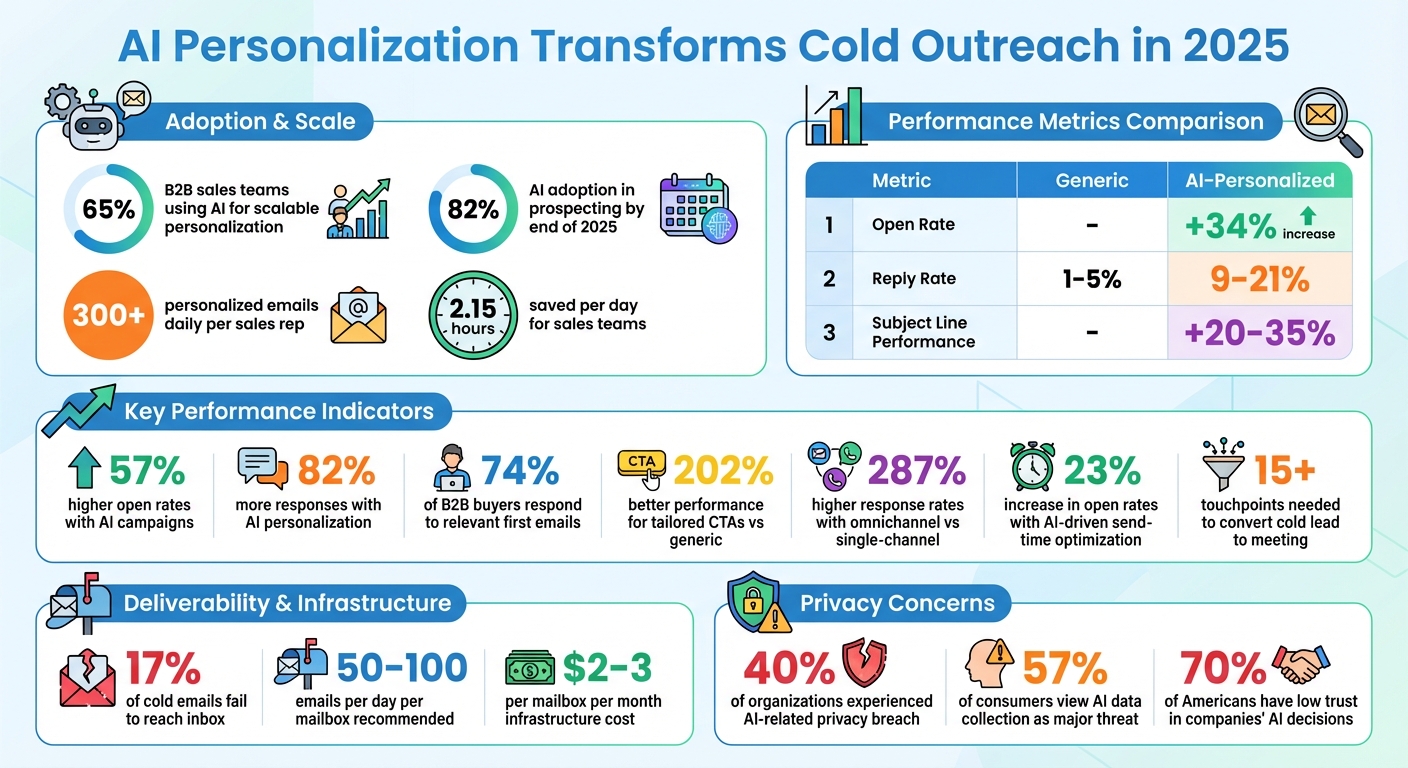
AI is transforming cold outreach in 2025 by helping businesses create highly tailored emails at scale. Instead of generic templates, modern tools analyze real-time data like LinkedIn activity, funding announcements, and job changes to craft messages that resonate. This approach has led to:
- 65% of B2B sales teams using AI for scalable personalization.
- 57% higher open rates and 82% more responses in campaigns using AI.
- AI-powered tools enabling 300+ personalized emails daily per sales rep.
The key trends include real-time personalization, advanced segmentation, and automated workflows. AI SDRs (Sales Development Representatives) now handle lead sourcing, outreach, and follow-ups, saving 2.15 hours per day for sales teams. However, success requires proper technical setups to maintain deliverability and avoid spam filters.
AI Personalization Impact on Cold Outreach Performance 2025
Key Trends in AI Personalization for Cold Outreach
Real-Time Personalization Using Behavioral and Intent Data
Cold outreach is evolving, thanks to dynamic, signal-driven messaging. Today’s AI tools can monitor live events - like funding announcements or executive role changes - to deliver messages at just the right time. For instance, autonomous AI SDRs such as Agent Frank analyze behavioral signals and adjust outreach in real time. These systems identify key moments and craft personalized messages when prospects are most likely to engage.
This approach doesn’t stop at timing. It also digs deeper into behavioral and psychographic insights, enabling hyper-focused personalization.
Advanced Personalization: Going Beyond Basic Variables
AI-powered personalization now extends far beyond simple details like job titles. Psychographic segmentation lets marketers target prospects based on their intent and behavior. For example, instead of reaching out to all CMOs, AI narrows the focus to those actively exploring alternatives to their current tools. Using Natural Language Generation (NLG), AI mimics a brand’s tone while injecting empathy into messaging at scale. The results speak for themselves: subject lines generated by AI boost open rates by an average of 34%, while tailored calls-to-action outperform generic ones by 202%. Moreover, 74% of B2B buyers say they’re more likely to respond when the first email demonstrates relevance.
This trend toward ultra-targeted offers allows AI to address specific pain points. Whether it’s a personalized audit, a competitor case study, or a free report tackling a particular challenge, the goal is to deliver real value. However, there’s a fine line - overdoing personalization can come across as intrusive. The most effective strategies focus on showcasing genuine understanding rather than overwhelming prospects with excessive data.
"AI is not here to write for you - it's here to accelerate your creativity and make every prospect feel like you wrote just for them." - Sarah Nguyen, VP of Growth, Outreachly
AI’s influence doesn’t end with content. It’s also revolutionizing how and when messages are sent, ensuring outreach is as effective as possible.
AI-Driven Send-Time and Sequence Optimization
Machine learning now takes the guesswork out of timing and delivery. By predicting the best time and channel for each prospect, AI can increase open rates by 23%. But it doesn’t stop there - sequence optimization fine-tunes everything from follow-up timing to message length, adapting based on how prospects engage with earlier emails. Omnichannel strategies, which combine email, LinkedIn, and phone outreach, see response rates soar by 287% compared to single-channel efforts. Platforms like Salesforge make this possible, seamlessly switching between channels based on where prospects are most engaged.
This level of precision ensures that outreach feels timely, relevant, and compelling, setting the stage for stronger connections and better results.
AI SDRs and Automated Personalization Workflows
AI SDRs: Automating the Sales Funnel
AI SDRs are changing the way sales teams handle their daily operations. These systems take care of lead sourcing, personalized outreach, and scheduling meetings without human intervention. For example, Agent Frank from Salesforge automates the entire outbound process - finding potential leads, creating tailored messages, and managing follow-ups and meeting schedules around the clock.
On average, sales professionals reclaim 2.15 hours per day by automating repetitive tasks like data entry and follow-ups. Using natural language processing, AI SDRs can classify responses as positive, neutral, or negative. When a lead shows interest, the system routes them to human sales reps, while objections pause outreach sequences. This automation ensures that even multi-channel efforts maintain the precision of hyper-targeted personalization.
However, the technical setup is just as critical as the AI itself. For effective deployment, email volumes must be distributed across multiple domains and mailboxes to simulate natural sending behavior and safeguard sender reputation. Isabella L., Founder of Let's Fearlessly Grow, emphasized the importance of this infrastructure:
"We needed to build an outbound motion that didn't break as we scaled - and Mailforge gave us that foundation".
With mailbox costs ranging from $2 to $3 per month, this setup is cost-effective for teams of any size. Beyond email, AI SDRs are evolving into complete outreach solutions that integrate seamlessly with multiple platforms.
Multi-Channel Outreach with AI Integration
AI SDRs don’t stop at email - they excel at coordinating outreach across various platforms, ensuring prospects are engaged wherever they are most active. This is vital since it now takes an average of 15+ touchpoints to convert a cold lead into a meeting. By spreading these touchpoints across channels, teams can significantly improve their results.
Salesforge simplifies multi-channel outreach by combining LinkedIn integration and mailbox management into one streamlined interface. Tools like Calendly are also integrated, making the transition from initial contact to scheduled meeting effortless. What once required juggling multiple tools and manual coordination is now a fully automated, unified workflow.
Impact of AI Personalization on Deliverability and Performance
Effective cold outreach hinges on balancing advanced personalization with strong deliverability and reliable performance. Let's explore how AI-driven personalization influences these critical aspects.
Deliverability Challenges in AI-Driven Outreach
As AI personalization becomes more sophisticated, ensuring email deliverability has emerged as a pressing challenge. While AI can enhance engagement, it can also inadvertently trigger spam filters if not properly configured. This problem, referred to by experts as the "Seventh Age" of Deliverability, underscores the complexities of modern email systems. Providers like Gmail and Yahoo now use their own AI to summarize emails, sometimes overriding carefully crafted subject lines and preview text with automated alternatives.
The stakes are high. Gmail penalizes sender reputation when emails are sent to subscribers who haven’t engaged in six months, making engagement history a critical factor. Statistics reveal that 17% of cold emails fail to land in the inbox. Overly creative AI-generated content can confuse email summaries, leading to spam complaints and lower engagement rates. Additionally, sending large volumes of emails without a proper warmup process can cause lasting damage to your domain's reputation.
To avoid these pitfalls, technical configurations like SPF, DKIM, and DMARC are essential. Platforms such as Salesforge simplify these setups and offer tools like Warmforge to gradually build sender reputation. High-volume outreach also benefits from distributing emails across multiple domains and mailboxes to simulate natural sending behavior. For example, Salesforge’s Mailforge infrastructure supports this approach at a cost-effective $2 to $3 per mailbox per month - far cheaper than traditional Google or Microsoft workspace options. To maintain a healthy sender reputation, limit sending to 50–100 emails per day per mailbox.
With these safeguards in place, AI personalization can deliver measurable performance gains.
Performance Benchmarks for AI Personalization
AI-driven personalization significantly outperforms generic outreach efforts. Companies leveraging AI personalization report an average 34% increase in open rates. Even AI-crafted subject lines alone can boost open rates by 20% to 35%. More impressively, reply rates for AI-personalized campaigns range from 9% to 21%, compared to just 1% to 5% for generic campaigns.
| Metric | Generic Outreach | AI-Personalized Outreach |
|---|---|---|
| Open Rate Increase | Baseline | +34% average |
| Reply Rate | 1–5% | 9–21% |
| Revenue Impact | Baseline | +50% (via segmentation) |
| Campaign Volume | Baseline | -70% (same revenue with fewer sends) |
These numbers highlight the transformative potential of AI personalization.
"When one company started segmenting by engagement recency and excluding unengaged subscribers, they saw a 50% increase in revenue while sending 70% fewer campaigns." - Stephanie Donelson, Attentive
This example underscores the importance of prioritizing quality over quantity. Gmail’s penalties for low engagement further reinforce this principle. By combining AI personalization with smart segmentation and a solid technical foundation, businesses can focus on engaged prospects, maintain sustainable sending practices, and scale personalization effectively.
Future Directions in AI Personalization for Cold Outreach
By 2026, AI is expected to handle entire deal pipelines - from drafting emails and managing workflows to adapting outreach strategies in real time based on engagement signals. This means AI won’t just be a writing assistant anymore; it will take on the role of a full-cycle deal manager, analyzing opportunities as they arise and fine-tuning outreach tactics dynamically.
Reinforcement Learning and Revenue-Driven Personalization
The biggest shift on the horizon is how AI learns and optimizes its processes. Revenue-driven personalization will replace superficial metrics with strategies focused on actions that directly drive deals.
"We believe 2026 will mark a major inflection point: the shift from AI assistance to AI orchestration." - Outreach
The next wave of AI innovation prioritizes insight generation over simple content creation. Instead of churning out generic text, AI will analyze signals like website activity, hiring trends, and competitor movements to guide highly targeted outreach campaigns. For example, if a company posts multiple job openings, AI could interpret this as a scaling effort and respond with outreach tailored to address those challenges.
This evolution paves the way for platforms to unify and streamline outreach workflows. Tools such as Salesforge's Agent Frank are already moving in this direction, coordinating multi-channel efforts across Sales, Marketing, and RevOps. The future lies in integrated AI platforms that eliminate the inefficiencies of disconnected tools, creating a seamless system for outreach management.
Privacy and Ethics in AI Outreach
As AI sharpens its ability to personalize outreach, privacy and ethical concerns grow more urgent. While revenue-driven AI relies on detailed personal data, this dependence raises significant challenges. According to Gartner, 40% of organizations have experienced an AI-related privacy breach, and 57% of global consumers view AI data collection as a major privacy threat. Regulatory pressures are also increasing - GDPR fines topped €1.7 billion in 2024, and the EU AI Act, effective in 2025, introduces risk-based classifications for AI systems.
One key issue is how AI models retain personal data during training, making it difficult to remove individual records without retraining the entire model. This "black box" challenge clashes with GDPR Article 22, which grants individuals the right to opt out of decisions made solely by automated systems. Furthermore, 70% of Americans report low trust in companies to make responsible AI decisions.
To address these concerns, organizations are turning to privacy-enhancing technologies and first-party data strategies. Federated learning (training algorithms on decentralized data), differential privacy (adding noise to obscure identities), and homomorphic encryption are among the methods gaining traction. A smarter approach involves shifting to "Smart Signals", such as tracking direct website engagement, rather than relying on third-party data scraping.
"One of the biggest trends shaping data privacy in 2025 is the accelerating convergence of AI governance and privacy compliance." - Ryan Johnson, Chief Privacy Officer, The Technology Law Group
Practical measures include data minimization - collecting only essential details like names, titles, and companies - along with human oversight for AI-generated priority lists and thorough audits of AI vendors for certifications such as SOC 2 and ISO 27001. By 2025, it’s projected that 60% of large organizations will use AI to automate GDPR compliance. Companies that combine personalized outreach with transparent, ethical data practices will be better positioned to earn the trust of privacy-conscious buyers.
Conclusion
AI-driven personalization has become a cornerstone for successful cold outreach in 2025. The numbers speak for themselves: 74% of B2B buyers respond to relevant emails, and AI adoption in prospecting has reached 82% by the end of the year. Companies leveraging AI-powered personalization have seen reply rates soar from 9% to 21%.
The most effective strategies combine hyper-personalization at scale with solid infrastructure. AI tools now analyze LinkedIn profiles, company websites, and press releases to craft tailored outreach while ensuring sender reputation through proper technical setups. Platforms like Salesforge's Agent Frank lead the charge, automating the sales funnel - from lead generation to scheduling meetings - all while retaining the human touch that prospects value.
Looking ahead, the evolution of cold outreach promises even more dramatic shifts. As AI moves from simply assisting to orchestrating workflows, sales teams are set to operate with unprecedented precision. The focus will shift toward revenue-driving personalization, replacing vanity metrics with actions that directly close deals. However, these advancements come with challenges: 40% of organizations have already faced AI-related privacy breaches. This highlights the importance of ethical data practices and strict compliance measures.
AI isn’t about replacing human insight; it’s about amplifying creativity and making every prospect feel individually addressed. The companies that succeed in 2025 and beyond will be those that embrace cutting-edge AI while prioritizing transparency and privacy. Whether you're just starting with AI personalization or fine-tuning your workflows, the time to act is now - because your competitors already are. Mastering AI personalization isn’t optional; it’s the key to staying ahead.
FAQs
How is AI transforming cold email outreach in 2025?
AI is reshaping the way businesses approach cold email outreach by making hyper-personalized messaging possible on a large scale. Leveraging advanced algorithms, it dives into data like behavior patterns, industry trends, and even tone preferences to craft subject lines, introductions, and calls-to-action that feel tailored to each recipient. The impact? Open rates have jumped by nearly 50%, and reply rates have climbed by up to 21% compared to generic, one-size-fits-all campaigns.
Beyond personalization, AI simplifies the entire outreach process. It automates time-consuming tasks like lead research, email validation, and follow-up scheduling. This means even small teams can send out hundreds of customized emails daily without compromising deliverability. Tools like Salesforge take it a step further by offering standout features such as multilingual email generation, automated inbox warm-ups, and an AI-powered SDR that handles everything - from prospecting to booking meetings.
By turning cold outreach into a data-driven and scalable process, AI helps businesses connect with potential clients more effectively, leading to stronger engagement and measurable results.
What privacy risks should I consider when using AI for personalized cold emails?
AI-powered personalization in cold emails brings undeniable value, but it also introduces privacy concerns that teams must navigate with care. These tools often rely on processing vast amounts of data - like behavioral insights and contact information - which can clash with regulations such as CAN-SPAM in the U.S., GDPR in the EU, and CASL in Canada. These laws demand clear consent or opt-out options, and non-compliance can lead to hefty fines. For instance, under CAN-SPAM, penalties can reach $46,517 per email.
One major pitfall is using scraped or purchased email lists. This practice often bypasses consent, increasing the likelihood of spam complaints, harming your sender reputation, and opening the door to legal trouble. On top of that, AI systems managing personal data must prioritize robust security measures and maintain accurate consent records to prevent breaches or compliance failures.
Platforms like Salesforge address these challenges by providing privacy-focused features. These include email validation, unlimited warm-up to safeguard sender reputation, and tools to efficiently manage consent and opt-outs. By sticking to legal guidelines and embracing ethical practices, Salesforge empowers teams to harness the power of AI-driven personalization without compromising compliance or trust.
How can businesses improve email deliverability with AI-powered personalization?
To make sure AI-personalized cold emails land in the primary inbox, businesses need to prioritize maintaining a strong sender reputation. One effective approach is using tools with automated email warm-up features. These tools gradually increase your email sending volume and simulate natural reply patterns, which helps reduce the chances of triggering spam filters. Pair this with email validation tools to verify addresses and cut down on hard bounces - these can negatively impact your domain's reputation.
AI can also play a key role in improving deliverability by creating dynamic and varied email content. Techniques like spin syntax and dynamic fields allow you to tweak subject lines, phrases, and calls-to-action, ensuring each recipient gets a unique message. This not only boosts engagement but also helps steer clear of spam triggers. Keeping an eye on sender health metrics, such as bounce rates and spam complaints, is equally important to keep campaigns running smoothly. By combining these methods, businesses can scale their personalized outreach efforts while maintaining high deliverability rates.

.png)
